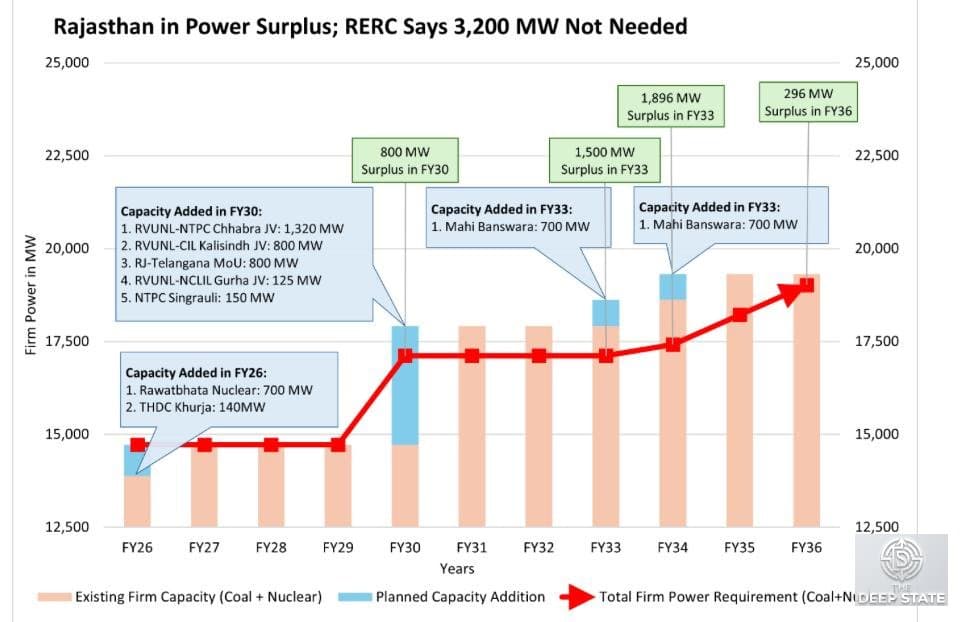
Jaipur: In a significant decision, the Rajasthan Electricity Regulatory Commission (RERC) has found that Rajasthan already has sufficient coal and nuclear capacity planned or tied-up to meet its firm power requirements till FY 2035-36. This decision has effectively put on hold Rajasthan Urja Vikas Nigam Ltd.’s (RUVNL) plans to procure 3,200 MW of new coal-based power through competitive bidding.
The order, passed in Review Petition No. 2388 of 2025, does not reject the Tariff-Based Competitive Bidding (TBCB) route outright, but surrounds it with conditions so demanding that proceeding with the 3,200 MW proposal appears untenable.
The State is Already in Surplus
The Commission has observed that, after accounting for already planned and tied-up capacities, firm requirement for additional long-term firm coal-based power does not exist. Acknowledging the prudent and well-coordinated power planning of the state, the Commission has observed that if the planned capacities are commissioned in a timely manner, Rajasthan is unlikely to face any long-term power shortage.
The Commission has notably observed that given the advanced stages these MoUs have progressed to, such as cabinet approvals and formation of JVs with established and credible PSUs, the Discoms “ought to take all coordinated and time-bound steps to expedite the requisite approvals …., so that the said capacities are commissioned at the earliest in the interest of robust planning, …… consumer interest in the true spirit of the Electricity Act 2003”.
TBCB Route Not Barred; But the Conditions are Formidable
Para 114 of the order does leave a door open for TBCB procurement, but it is a narrow one. The Commission says that if the Discoms choose to go the competitive bidding route and in doing so cancel or exclude any of the currently planned/tied-up capacities listed above, they must carry out a rigorous assessment of the residual requirement. Para 114 effectively directs that such an assessment must:
* Account for all retained planned capacities, including nuclear;
* Factor in operational factors such as historical Plant Load Factor (PLF), detailed modelling, and actual peak-time contribution if any existing capacity is proposed for retirement by Utpadan Nigam;
* Incorporate the concept of Capacity Credit and Planning Reserve Margin as per MoP's Resource Adequacy Guidelines, 2023;
* Be approved by the Board of Directors of RUVNL and subsequently by the Government of Rajasthan.
Only after this multi-step process can any fresh procurement be initiated, and only for the capacity shortfall this process reveals. The Commission reiterates that the “optimum combination of tie-up for 4,440 MW of coal capacity during 2025-26 to 2035-36 is the decision of the Discoms keeping in view the transparent process and optimal cost”, making consumer interest and cost optimality non-negotiable filters that any TBCB proposal must pass.
Why the TBCB Route May Itself Fail the Consumer Interest Test
The Commission, while not ruling on comparative tariffs with finality, has at several places in the order highlighted that the MoU/JV-based expansion route may simply be cheaper and in the interest of the consumers of Rajasthan. The Commission noted that nuclear sources merit “serious consideration in long-term planning from the standpoint of supply security, system efficiency and consumer interest”. It added that the Discoms may explore securing the maximum feasible share from in-state nuclear sources such as the Rawatbhata and the Mahi Banswara projects wherever “economically prudent”.
The Commission also endorsed the Tariff Policy, 2016 – often cited by Urja Vikas to argue for procurement through competitive bidding only – which expressly carves out exceptions for expansion of existing thermal projects and procurement from State Gencos. The Policy further acknowledges that such expansion projects derive cost advantages from shared infrastructure, with those benefits meant to flow to consumers.
MoUs Cannot Simply Be Abandoned
Besides, the Commission notes that existing tied-up capacities under MoUs and JVs are “not matters lying solely within the petitioner’s unilateral domain”.
The existing tied-up capacitates consist of several MoUs executed between Rajasthan’s Utpadan Nigam and Central Public Sector Undertakings (CPSUs) such as CIL and NTPC (which the Commission has observed to be credible partners). In case of Rajasthan’s MoU with Telangana for 800 MW coal power, the State Cabinet itself has approved equity allocation on November 19, 2025.
Urja Vikas, by itself, cannot unilaterally cancel these MoUs and JVs on behalf of Utpadan Nigam or the State Cabinet.
The Commission goes further that if Urja Vikas believes certain MoU-based projects should be dropped from the planning horizon in favour of the procuring any quantum of power through the competitive bidding route, the appropriate course is to first take a “clear and final decision regarding cancellation,” including approval from the competent authority at the same level at which those projects were originally sanctioned. Mere apprehension of delay or absence of a signed Power Purchase Agreement cannot justify disregarding them.
The Commission also pointedly observes that the MoUs are approximately 1.5 to 2 years old, and the 3,200 MW TBCB was also being considered for around a year. Yet no comparative study or analysis was placed on record to explain why TBCB would serve consumer interests better than the MoUs of state’s own genco – Utpadan Nigam.
The Disposal: No Approval
The Commission disposed-off the Review Petition by directing Urja Vikas to prepare an updated Resource Adequacy Plan, updated annually on a rolling basis, and to undertake the methodology outlined in the Order before approaching the Commission again with any fresh procurement proposal.
In effect, the order sends Urja Vikas back to square one: prove the need, cancel any excess capacity under existing tie-ups with appropriate approvals, show that TBCB is cost-effective for consumers, and then come back.